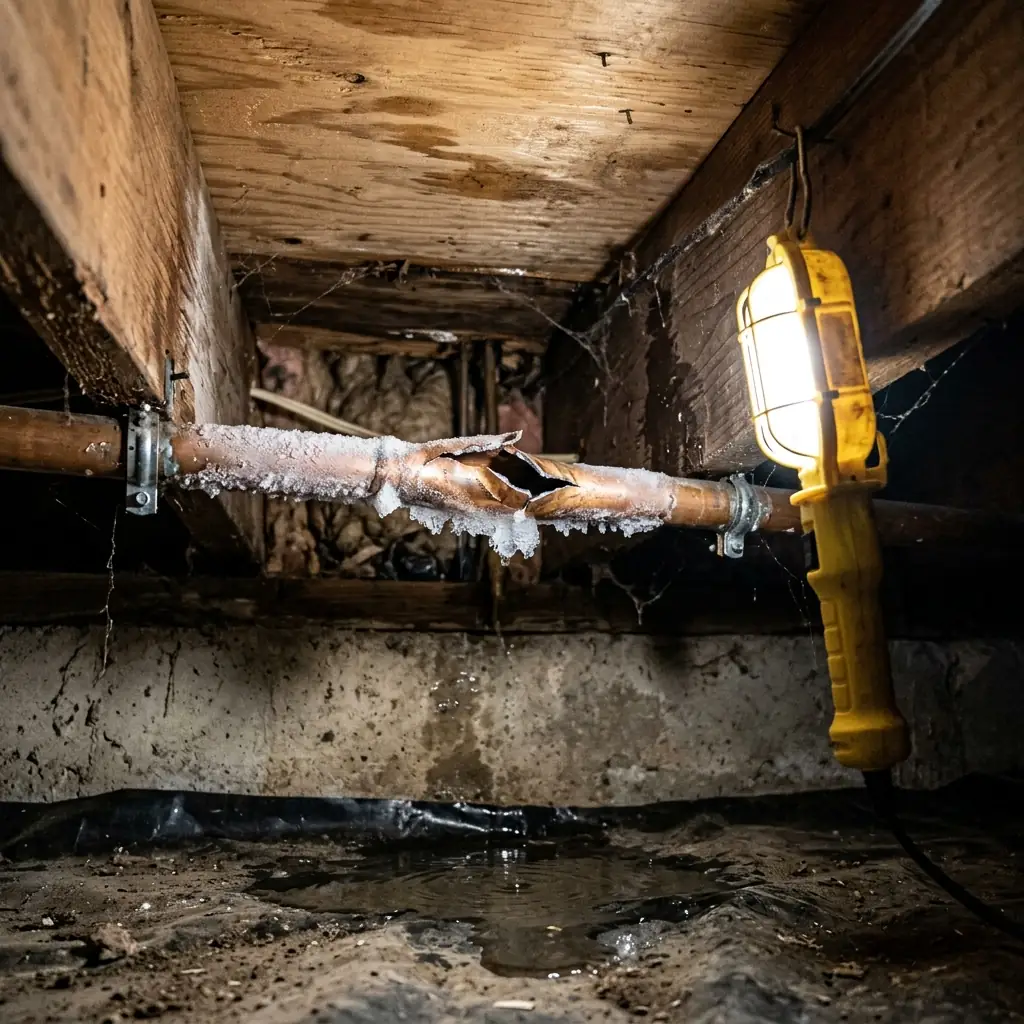
Why Coppell's Larger Homes Carry More Freeze Risk, Not Less
When winter storm Uri held North Texas below freezing for days in February 2021, the homes that flooded worst weren't the oldest ones. They were often the biggest. A sprawling two-story home has long supply runs feeding upstairs bathrooms, wet bars, and laundry rooms, and much of that pipe travels through an attic that sits at outdoor temperature during a freeze. Coppell's housing stock skews toward exactly this profile: larger square footage, multiple bathrooms, second stories over finished living space. More plumbing in more cold air means more failure points, and a burst upstairs line drains through the ceiling into the room below before anyone hears it.
The Attic Is Ground Zero in a Two-Story Coppell Home
In the slab-on-grade construction standard across Coppell, under-slab supply lines stay protected by ground temperature that never drops below freezing. The danger lives above your head. Supply lines crossing an uninsulated attic, pipes tucked into exterior wall cavities, and lines feeding second-floor fixtures are the ones that freeze first. Outdoor hose bibs and irrigation supply lines round out the list. Because so much of the risk in a Coppell home is in the attic specifically, it's worth reading our attic water damage page, since an attic burst is the single most destructive freeze scenario for a two-story house.
Your Freeze-Prep Checklist, in Priority Order
The moment a freeze watch posts for North Texas, work top to bottom. Disconnect and drain every garden hose, because a hose left attached backpressures the bib and freezes it from the outside in. Wrap accessible attic and garage pipe runs in foam insulation sleeves, a few dollars each at any hardware store. In a long attic run, a single incandescent trouble light left on through the freeze often adds just enough heat to keep the line above freezing. Finally, open the cabinet doors under every sink on an exterior wall so household heat can reach the pipe behind it.
When the Forecast Turns Severe: The Drip-and-Shutoff Routine
Passive insulation buys you a lot, but a sustained hard freeze can outlast it. When the low is forecast to sit in the teens or below for a full day, let the cold-side faucets run a slow drip, because moving water resists freezing far better than still water. Find your main shutoff at the street meter now, in daylight, not at 2 a.m. with a flashlight. If a faucet you've opened goes dead with no flow, you likely have a frozen line. Never thaw it with a torch or heat gun. A hair dryer on low or warm towels is safe; a plumber is the next call.
The First Ten Minutes After a Burst
A burst pipe is a loss that compounds every minute it runs. Kill the water at the street meter first. If water has reached outlets, a panel, or a second-floor fixture draining onto electrical below, trip the affected breaker from a dry spot before you step in. Then photograph and film everything, the waterline on the wall, the soaked ceiling, the ruined flooring, before you move a single item. Skip the mop and shop vac. They just push water across more square footage and can't pull moisture out of the wall cavities and framing where mold takes hold within a day or two.
Freeze Claims and the Texas Vacancy Clause Trap
Standard Texas homeowners insurance covers a freeze-related burst as sudden and accidental damage. What decides the claim is proving the freeze caused it, not slow corrosion, which is why your restoration company's moisture report and the plumber's written failure diagnosis matter so much. There is one trap worth knowing in a community with second homes and frequent travelers: the vacancy clause. If the house sat empty with the heat off during the freeze, your insurer can argue negligence rather than a sudden event and reduce or deny the claim. Read your policy's vacancy provision before you leave town in winter.
The moment you find a burst pipe, shut off the main. Then call (972) 961-2394. Our burst pipe water damage crew handles emergency extraction, structural drying, and insurance documentation across Coppell, including North Lake Woodlands and every other neighborhood.