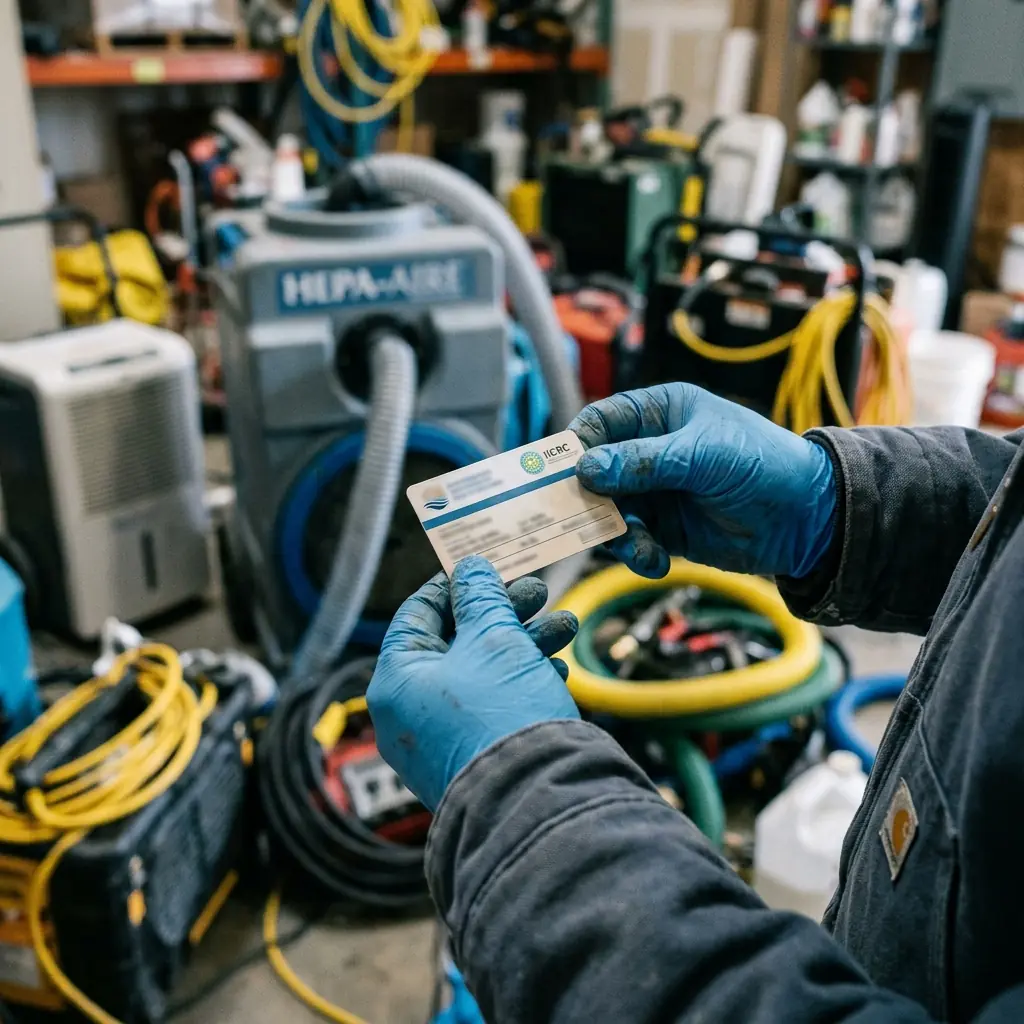
What does the word "certified" actually mean?
The two questions are: certified by whom, and to do what. A meaningful answer names the IICRC and specific field credentials. A vague one, "we're fully certified," with nothing behind it, is a red flag. Restoration is a technical trade with a written standard, and the companies that actually follow it can tell you exactly which credentials their on-site crew holds. The ones that can't are telling you something too.
What is the IICRC and what does it set?
The IICRC (Institute of Inspection, Cleaning and Restoration Certification) is an ANSI-accredited standards body that writes the technical rules the trade runs on, chiefly ANSI/IICRC S500 for water damage and S520 for mold. These aren't optional suggestions. They're the reference insurance adjusters, property managers, and code officials use to judge whether a job was done right. A crew that doesn't work to S500 isn't doing industry-standard restoration, whatever its marketing says.
Which field credentials should you ask for?
Two credentials matter on site. WRT (Water Restoration Technician) is the foundational one: the science of how water moves through a building, psychrometrics, moisture measurement, and the IICRC Category and Class system. ASD (Applied Structural Drying) builds on WRT and covers designing and monitoring a drying system for complex assemblies. Every technician we send in Coppell holds WRT at minimum, and our senior techs hold ASD. Ask which the crew coming to your home actually carries.
Where is the proof that drying was done right?
Standards are only worth what a company can document. A crew working to ANSI/IICRC S500-2021 produces a drying log: a daily record of moisture readings at every monitored point, proving the structure actually reached dry rather than just looking dry. It's also what your insurer wants to see. Ask any Coppell company whether they'll leave you the drying logs. A yes means they measure; a blank look means they don't.
How is certification different from a state license?
Certification and a state license are two different things, and a water damage restoration company should carry both. IICRC certification is a voluntary technical credential; it defines whether a company follows the standard, but Texas doesn't legally require it. A TDLR (Texas Department of Licensing and Regulation) Mold Remediation Contractor license, by contrast, is required by law for any mold remediation work in Texas. A company doing mold work without one is operating illegally. A full-service Coppell restoration contractor should hold both, and you can check the mold license at tdlr.texas.gov.
How to Verify Before You Sign
You don't have to take anyone's word. Individual IICRC credentials are searchable at iicrc.org, showing the technician's name, credential type, and issue and expiration dates, and because they require continuing education, an expired one isn't valid. Confirm the lead tech's current WRT before authorizing work, and the TDLR license before any mold scope. Five minutes of verification is less expensive than hiring the wrong crew.
Every Coppell job is worked to the ANSI/IICRC S500 standard, with a drying log you can check. Call (972) 961-2394 for emergency water damage restoration worked to ANSI/IICRC S500-2021, from Old Town to Gibbs Station.