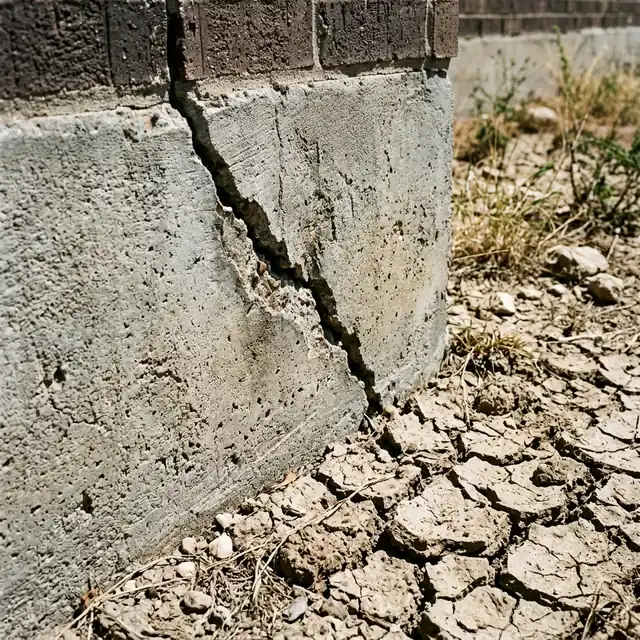
The Water Damage That Comes From the Ground, Not the Sky
Water damage doesn't only fall from above. In Coppell it also rises from below, driven by soil that changes shape with the seasons. This is a geological problem before it is ever a plumbing one, and it explains why two identical homes on the same street can have very different slab-leak histories depending on how the ground beneath each one behaves. Understanding the soil is the first step to understanding why the pipe broke.
Why Coppell Sits on Some of North America's Most Expansive Soil
Coppell lies squarely within the Blackland Prairie, a belt of clay-dominant soil that runs through much of North Texas and ranks among the most expansive ground in North America. Expansive means it doesn't just get muddy when wet; it physically changes volume. In a home built on an unstabilized slab, which describes most of Coppell's housing stock, that volume change can move the foundation vertically by inches over a single wet-to-dry season. The concrete is rigid. The ground under it is not. Something has to give.
The Swell-and-Shrink Cycle That Works Your Slab Every Year
Every spring, Blackland clay drinks up rainfall and swells, pressing up and inward against the underside and edges of your slab. Every summer it dries in the heat, shrinks, and pulls away, leaving voids where sections of the foundation lose their support. Repeat that lift-and-drop cycle year after year and the concrete develops micro-cracks, the plumbing joints embedded in it take repeated stress, and pipe runs that were laid straight slowly fall out of alignment. The damage is cumulative and quiet, which is exactly why it's so often missed until something fails.
Reading Foundation Movement in Your Home
Your house shows you when the soil has moved it. Watch for diagonal cracks running from the corners of doors and windows, doors and windows that suddenly stick or won't latch, floors that feel sloped or uneven underfoot, gaps opening where interior walls meet the ceiling or floor, and stair-step cracks in exterior brick. None of these are cosmetic. Each one says the foundation has shifted enough to affect the structure, and possibly the water lines running through it.
When Soil Movement Breaks the Pipes in Your Slab
The plumbing is where soil movement turns into water damage. When accumulated stress finally cracks a fitting or separates a joint in a line buried in the slab, water from a supply leak pushes up through the concrete and surfaces as a warm spot on the tile, a damp patch with no source overhead, or a water bill that jumps for no reason. Because the failure is under solid concrete, we locate it with FLIR thermal imaging rather than exploratory cutting, then our structural drying team dries the slab and affected walls to verified IICRC targets.
Warm or wet spots on the floor, or a water bill that climbed for no reason? Call (972) 961-2394. We trace under-slab moisture with thermal imaging and document the full scope before any cutting. Our burst pipe water damage service covers slab pipe failures across Coppell, including Cottonwood Estates and every other neighborhood.