Why a Slab Leak Is the Water Damage You Never Hear
A slab foundation is one continuous concrete pour that acts as both your ground floor and the structural base of the house, and it is what nearly every Coppell home sits on. The supply and drain lines run through and beneath that concrete before they ever reach a fixture. When one of those buried lines fails, the water has only two directions to travel: up through the slab into your flooring, or sideways under it through the soil. Neither announces itself. By the time a homeowner notices, the leak has usually been running for weeks.
Coppell's Aging Slabs: When 1990s Plumbing Hits Its Limit
Coppell filled in fast during the 1990s and 2000s, which means a large share of its homes are now 25 to 35 years old. That age matters. The copper and early-generation plumbing embedded in those slabs has spent decades flexing with the Blackland prairie clay beneath them, which swells in the wet season and shrinks in drought. Every one of those wet-dry cycles works at the fittings and thins the pipe walls where they rub against shifting concrete. A slab that gave no trouble for twenty years can start leaking simply because the plumbing inside it has reached the end of its service life at the same time across a whole neighborhood.
The Warning Signs, From Subtle to Obvious
Slab leaks reveal themselves in a rough order. First comes a water bill that creeps up with no change in how much you use. Then a warm spot underfoot on a tile or wood floor, a sign a hot-water line is leaking below. Later you may hear water running with every fixture off, or find a patch of flooring damp with no appliance or overhead source anywhere near it. The most advanced sign is the slab itself telling you: hairline cracks opening in the floor, or tile lines drifting out of square. A single one of these is worth a moisture assessment.
What It Costs to Wait
The damage from a slab leak compounds the longer it runs. Water migrating under the concrete erodes the supporting soil and opens voids, and voids are how a slab leak turns into a foundation-settling problem. Above the leak, moisture wicks up into flooring and the bottom plates of your walls, and the wall cavities next to a wet slab are exactly where mold sets up within a day or two. A leak caught at the water-bill stage is a plumbing repair and a drying job. The same leak caught six months later can involve foundation work. The gap between those two outcomes is entirely about how early it's found.
Finding the Leak Without Jackhammering Your Floor
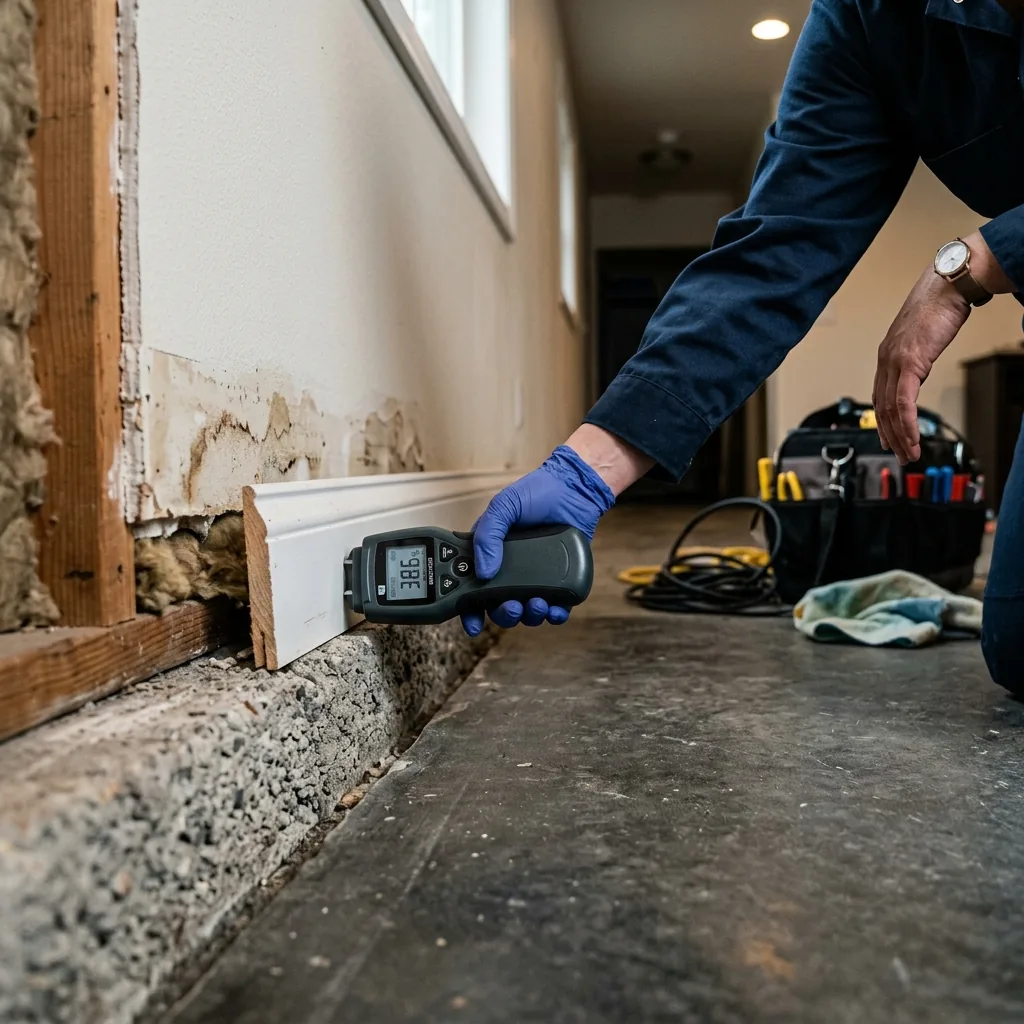
You do not have to open your slab to confirm a leak. We run FLIR thermal imaging to map where moisture is moving through the concrete and into adjacent walls, then handle extraction of any surface water and structural drying with LGR dehumidifiers placed to pull moisture back out of the slab and wall sections. We take daily moisture readings until every zone hits S500 drying targets, and apply antimicrobial treatment anywhere wood framing or drywall paper sat wet. Because the scope depends on how many zones and wall cavities the water reached, we track the job against verified readings, not a fixed calendar.
Suspect a slab leak in your Coppell home? Call (972) 961-2394. Thermal imaging confirms the moisture without cutting your floor open. Our burst pipe water damage service covers slab failures end to end, extraction through drying through insurance documentation, with a vetted local crew across every Coppell neighborhood.