Why isn't rain damage in Coppell just bad luck?
Homeowners tend to treat storm flooding as a freak event, but in Coppell it follows a pattern. The same neighborhoods take water in the same storms because the underlying conditions don't change between events. Once you know which conditions apply to your property, storm flooding stops being a surprise and becomes a risk you can plan for, insure against, and respond to quickly instead of scrambling.
When the Storm Outpaces the Drains
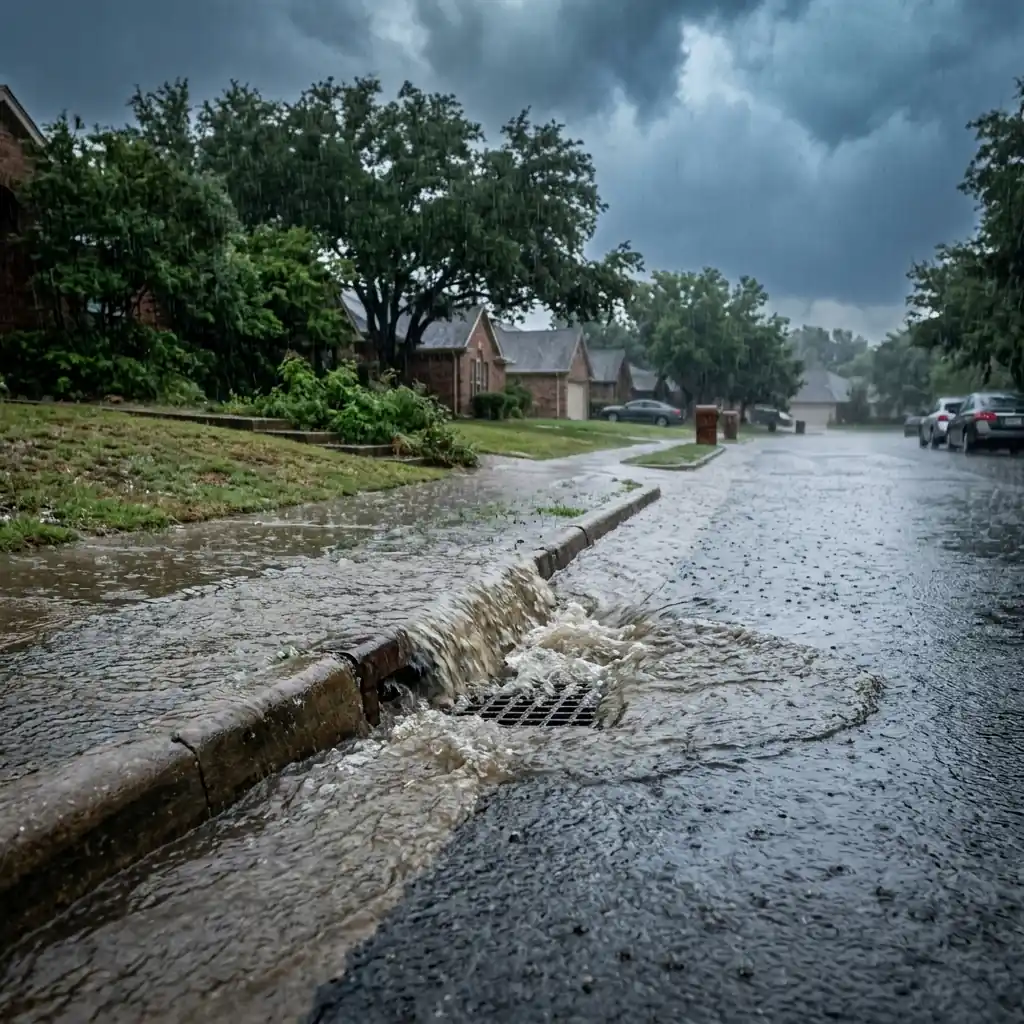
Coppell's storm drains handle steady rain fine. What they weren't built for is the multi-inch-in-a-few-hours downpour a North Texas spring can deliver with little warning. When rainfall arrives faster than the system can move it, the excess doesn't politely wait; it runs to the lowest point it can find, and that's often a foundation, a door threshold, or a wall penetration. The DFW area's recent extreme single-day rainfall events showed exactly what that capacity gap looks like at neighborhood scale.
How do Grapevine and Denton Creek overflow?
When those same storms overload Grapevine Creek or Denton Creek, the water doesn't stay near the channel. Properties in the northwest of Coppell, closer to the creeks and the Grapevine border, are the most exposed when a creek tops out. But the reach is wider than the banks: homes well away from any visible water can still take on floodwater backing up through shared storm-drain infrastructure when the whole system surges at once.
How do you find your FEMA flood zone?
The single most useful thing you can do is look up your address at the FEMA Flood Map Service Center, msc.fema.gov, which returns your zone in seconds. Zone AE means you're inside the mapped 100-year floodplain with a base flood elevation, and a mortgage lender almost certainly requires NFIP flood insurance. Zone X is moderate risk with no lender requirement, but don't read that as safe: the same storms that flood AE properties routinely reach X properties when creek volumes run high.
Why isn't storm water a DIY cleanup?
Storm and creek floodwater is Category 3 under the restoration standard, water that has crossed the ground, drainage, or a waterway and picked up contamination that carries a health risk. A shop vac doesn't touch the moisture soaked into walls and subfloor, which is exactly where mold sets up within 24 to 48 hours. Proper extraction and disinfection is the job: extract the water, establish a moisture baseline, and verify baseboards and adjacent rooms with meters, not a wet-vac and a fan, and the sooner it starts the less of the house it involves.
How do you lower your flood risk before spring?
If you're near Grapevine or Denton Creek or any low stretch of Coppell, check your FEMA zone ahead of storm season, and if you're in Zone AE without NFIP coverage, call your agent now rather than after. A vetted surveyor can produce an elevation certificate that may cut your NFIP premium if your home sits above base flood elevation; pricing varies by property, so get a direct quote. Prevention here is mostly paperwork and timing, both less expensive than a flooded first floor.
We respond across every Coppell neighborhood, 24/7. Our flood damage restoration service runs from Category 3 extraction through structural drying and mold prevention. Storm intrusion already happening? Call (972) 961-2394, a live dispatcher answers every call, whether you're near Huntington Ridge or anywhere else in the city.